
Definition of street marketing
At first glance, street marketing, also known as on-street marketing or urban communication, is a set of communication techniques used in public space to reach passers-by where they live, work or travel.
Unlike traditional advertising (TV, radio, static posters), street marketing relies on direct engagement, proximity, originality and often interaction with the public. It comes to life in streets, squares, markets, campuses, public transport or outside busy events (festivals, trade fairs, stadiums).
In 30 seconds: street marketing means going out to meet your audience in the street with a visible, mobile or surprising medium, carrying a short message, over a chosen period. It is measured by the traffic it generates (visits, scans, promo codes) and differs from standard poster advertising through human contact and freedom of placement.
Street marketing rests on a simple belief: the street is the best medium for creating real, aspect and memorable contact.
Street marketing, guerrilla marketing, urban marketing: what is the difference?
The terms overlap, but they do not mean the same thing.
- street marketing : the umbrella term. Any communication action carried out in the street, with or without a physical medium, with or without formal authorisation.
- Guerrilla marketing : the hard-hitting version, often unauthorised, playing on surprise and virality. Effective once, risky for a brand with a local reputation to protect: fines, removal, bad press.
- urban marketing or urban activation : street marketing designed as a full set-up, with mobile media (bikes, screens, trailers), ambassadors, permits and measurement. This is Yuba’s approach.
- urban communication : a broader term that also covers fixed posters, signage and cities’ own communication.
Our article 7 misconceptions about urban marketing and mobile advertising debunks the clichés that still stick to these practices.
The objectives of street marketing
Here is what a good street marketing campaign can do:
- Drive traffic to a physical or online point of sale
- Launch a product or service with impact
- Raise awareness of a brand or event
- Offer an immersive experience to your audience
- Build loyalty through surprise or a memorable gesture
- Highlight commitments (ethical, local, CSR)
- Get around the limits of traditional advertising in dense urban areas
- Create content with strong sharing potential on social media
The strength of street marketing lies in its versatility and flexibility : whether it is a launch, a rebrand, a promotion or simply getting a message out, there is always a suitable format.
8 effective media for a street campaign
At YUBA, we have developed a full range of media to occupy the ground strategically and creatively. Each medium has its ideal setting:
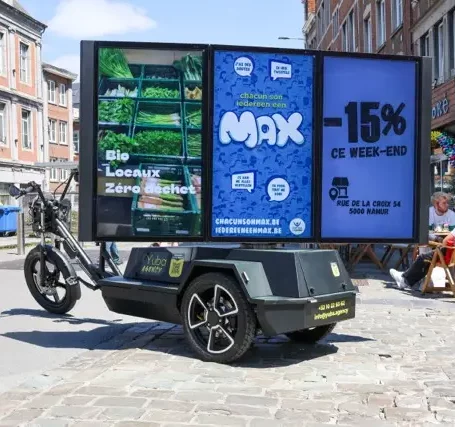
1. The advertising bike
Mobility, ecology, visibility : the Advertising bike is the perfect ambassador for all your local campaigns. A brand ambassador rides, stops at hotspots (markets, stations, festival entrances), hands out material and talks with people, all while flying your colours. Banner bike, illuminated banners for the evening or bike taxi: our article Which type of advertising bike to choose compares the formats. Ideal setting: large urban areas, campaigns of 1 to 4 weeks.
2. The Screenbike video bike
Three 55-inch UHD screens on a 100% electric bike: on the move they form a triangle visible from every side, and when parked they unfold into one giant screen. The Video bike shows your video in the heart of pedestrian zones, exclusively or shared with other advertisers via Yuba Media, with broadcast tracking in Yuba Live. Ideal setting: pedestrian zones and town centres, 1 to 10 days.
3. Clean tag and chalk tag
Mark pavements with a temporary, surprising message. A clean tag means cleaning the ground with pressurised water through a stencil, revealing a clean message that stays visible for 2 to 8 weeks. A chalk tag uses biodegradable chalk-based paint, colourful and temporary. These formats are perfect for directing people to a place, intriguing passers-by and repeating a slogan along a whole route. Advantage : they turn the ground into a communication channel without visual clutter. Ideal setting: pavements and pedestrian squares.
4. The backpack screen
Picture a mobile ambassadormoving through the crowd and wearing a backlit backpack screen : two illuminated posters for your message, your QR code or your product teaser. It is the illuminated version of the sandwich board, widely used at events and for evening campaigns. Ideal setting: stations, fairs, festivals, Christmas markets.
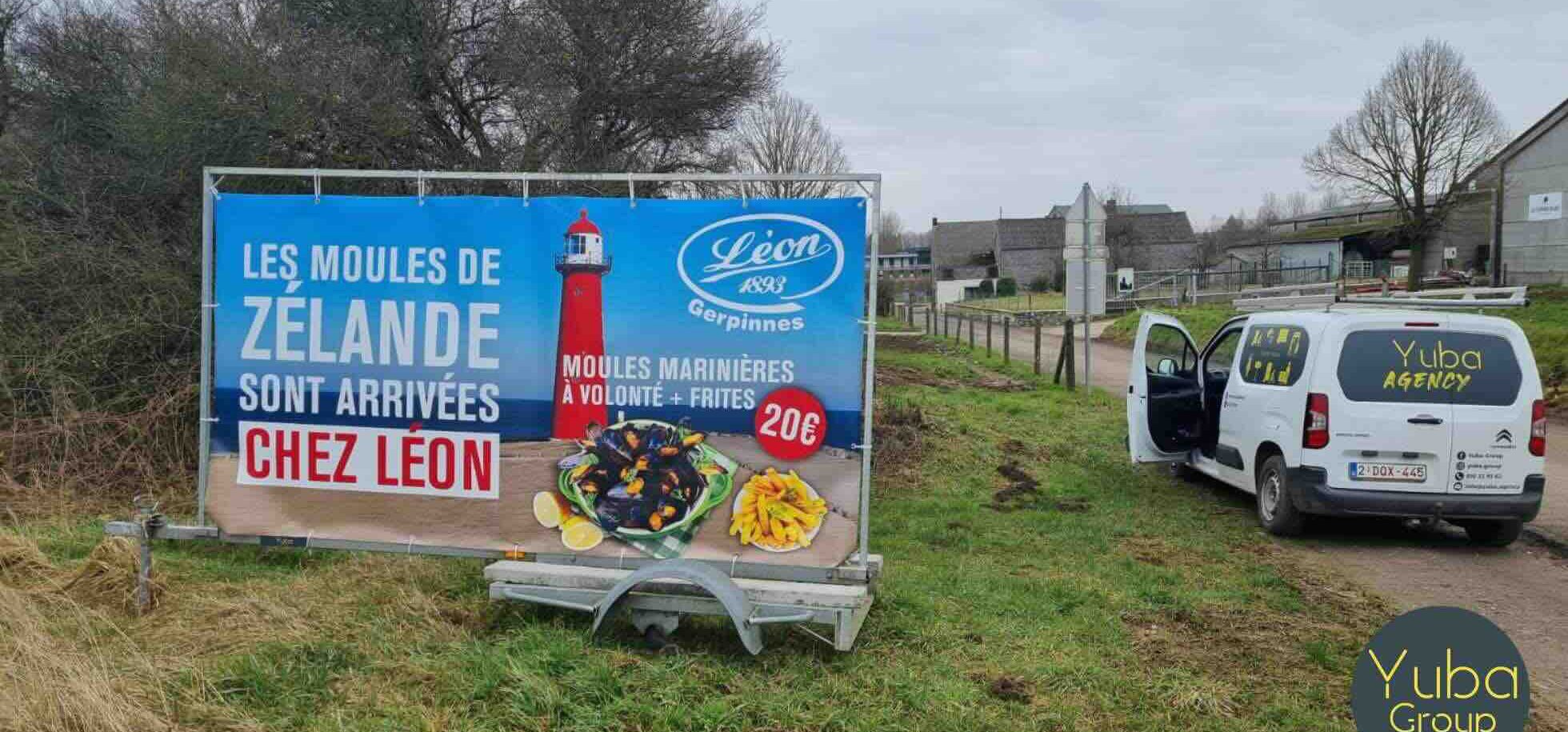
5. The advertising trailer
Placed by the roadside, at the entrance to a business park or near an event, the Advertising trailer offers 2 × 6 m² (double-sided) of visibility where nobody expects advertising. It stays up to a month per location, then moves on. Ideal setting: main roads, business parks, mass coverage.
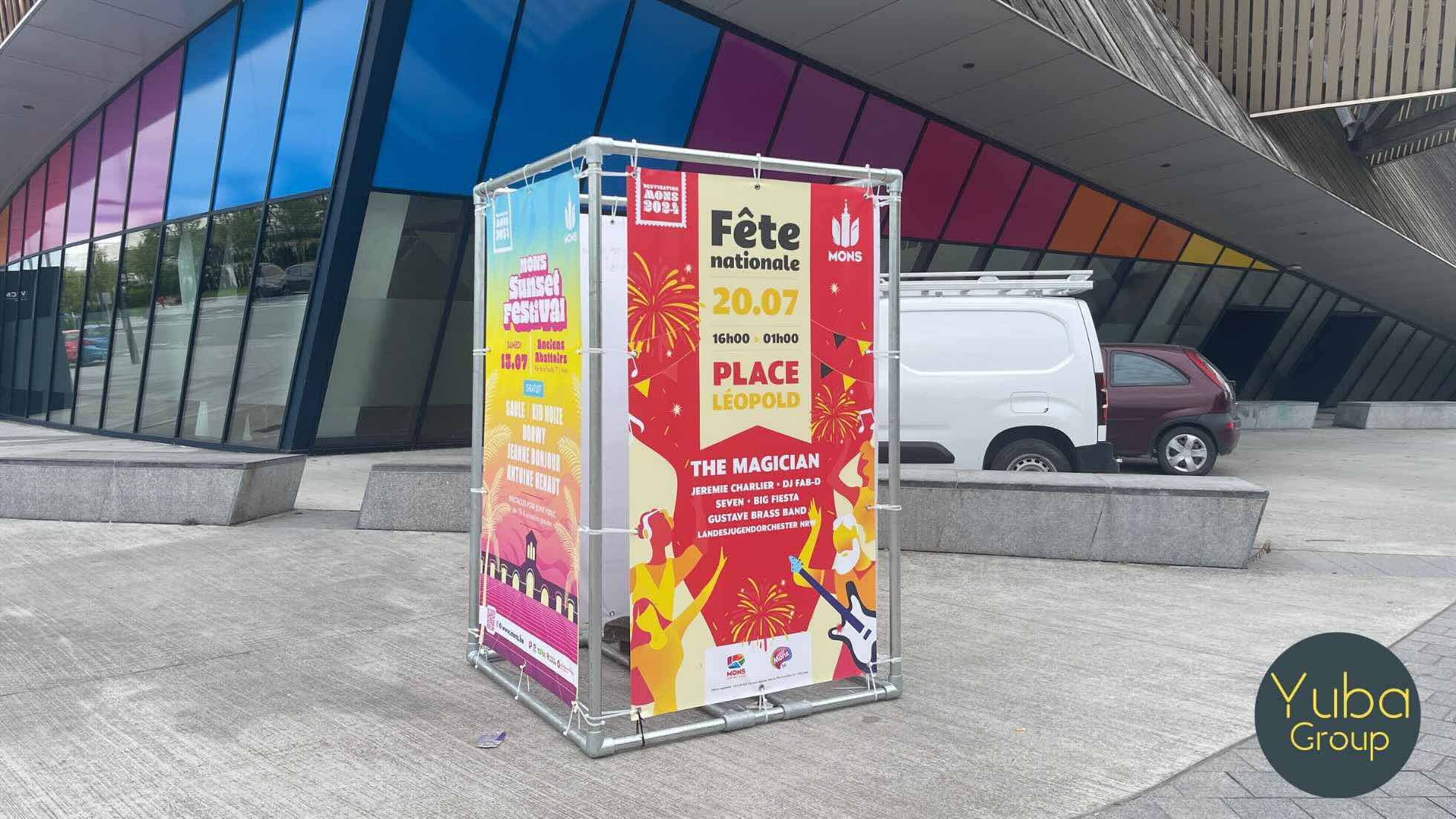
6. The advertising cube
Four printed sides, two sizes : the Advertising cube is a volume placed somewhere unexpected, catching the eye from every side and sparking instant curiosity. Hire it for a trade fair or buy it for your shop. Ideal setting: events, forecourts, halls.
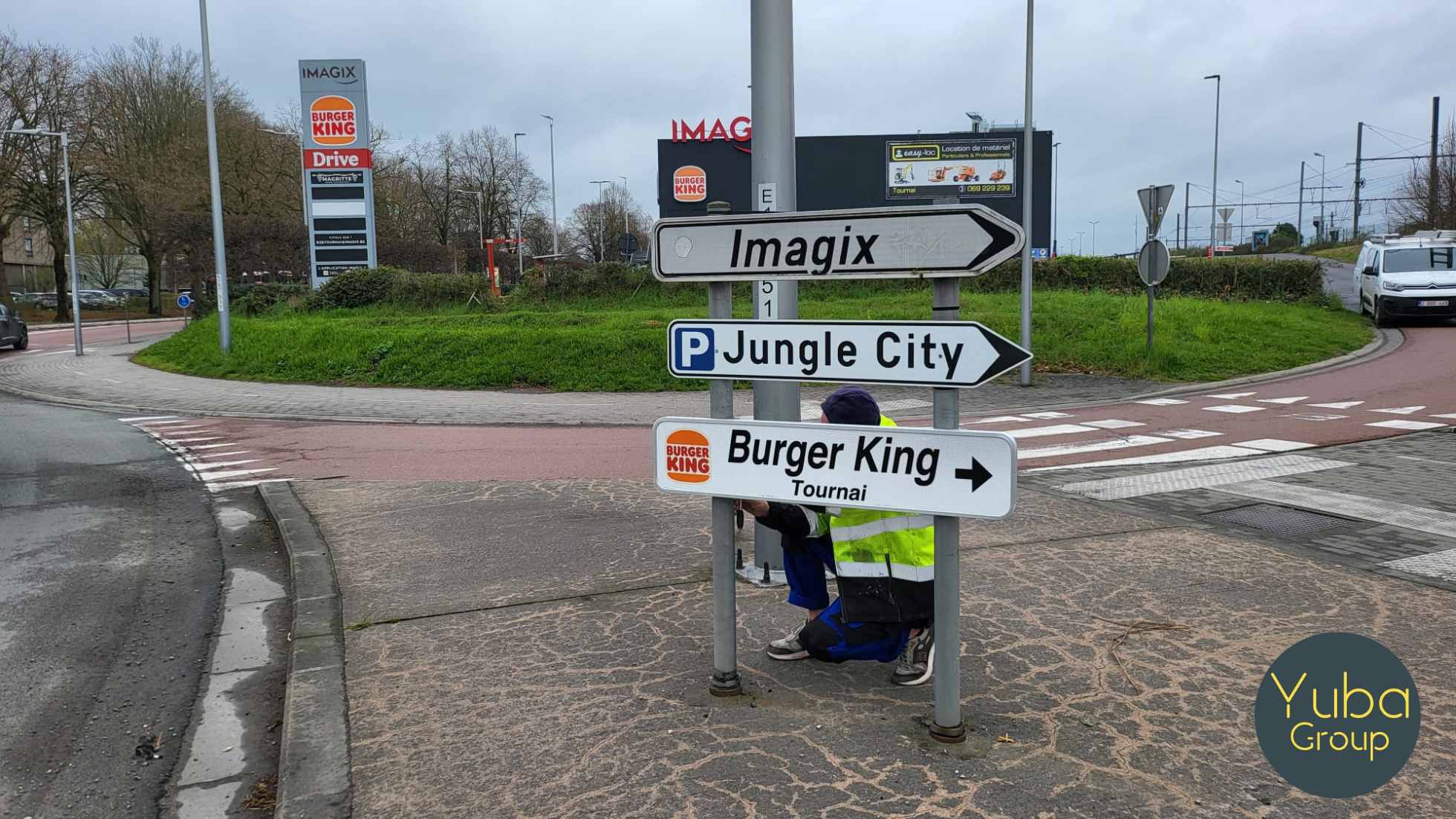
7. Road signage and car park line marking
In collaboration with local councils, Yuba provides approved directional signage, temporary for an event or permanent for your premises, installed with the mandatory authorisation of the road authority. Ideal setting: around a site, access to an event.
8. Door-to-door distribution and outdoor advertising
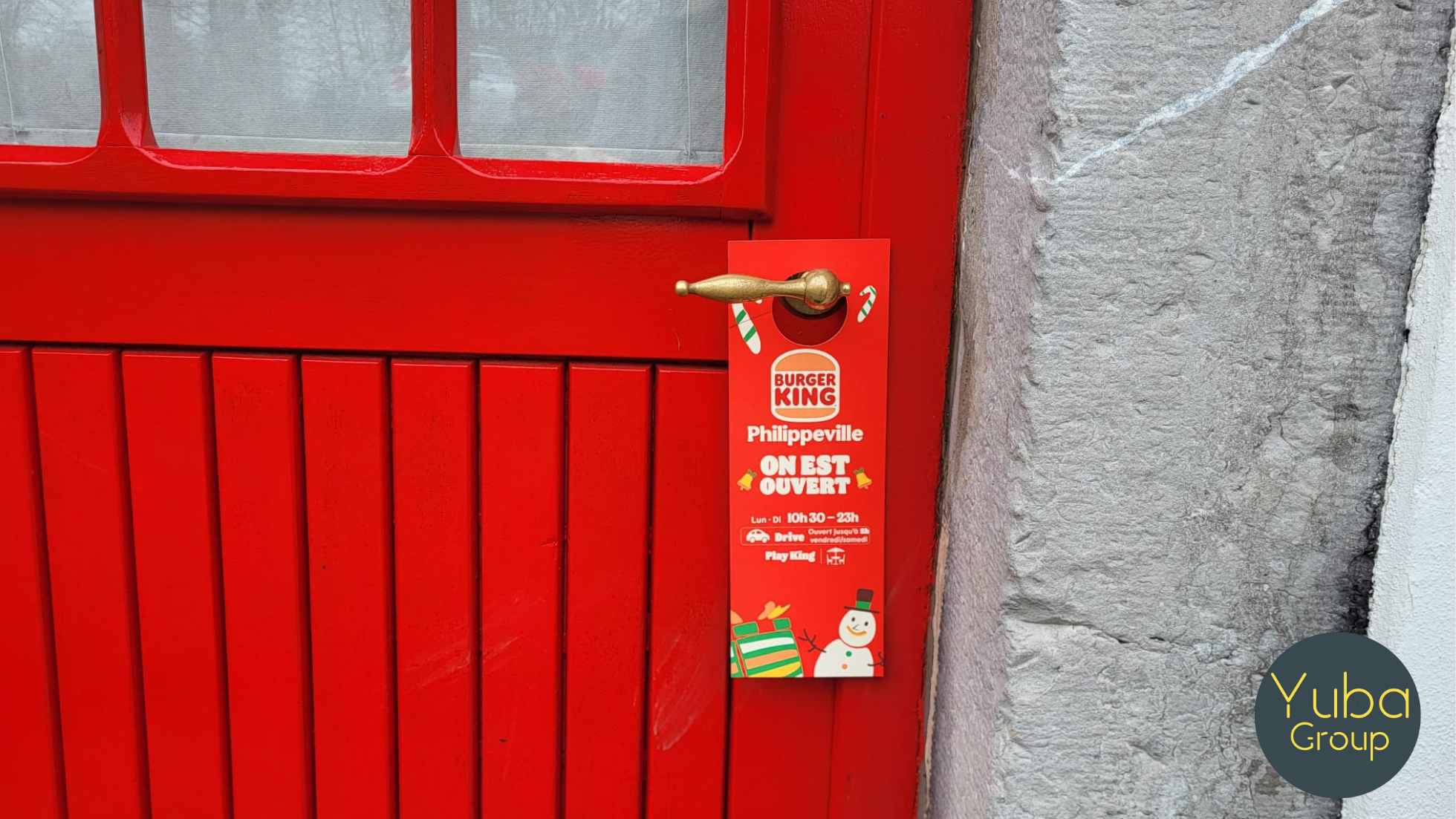
Direct distribution in letterboxes or on door handles (door hangers and flyers) reaches residents in a specific area. Signs, window graphics, beach flags, totems and pavement signs then anchor your presence on your shopfront. Ideal setting: a shop’s catchment area, an opening.
Examples of street marketing campaigns in Belgium
A few set-ups run by Yuba, to show what each medium delivers on the ground. All campaigns, with photos, are on the page our work.
- Visit Wallonia, Namur : a screenbike touring the city during “Namur en mai”, showing the programme on video in the heart of the pedestrian zones.
- Croix-Rouge de Belgique, Namur : advertising bikes and media to mobilise blood donors, with ambassadors who explain and guide. The set-up is described in When urban marketing helps the Red Cross.
- La Nuit des Musées, Mons : backpack screens to guide visitors from one site to the next as night falls.
- Kidzik festival, Louvain-la-Neuve, and LaSemo, Enghien : colourful chalk tags marking the route for families to the festival site.
- HELDB, Brussels : chalk tags around the school for its open days.
- Burger King, Philippeville : a backpack screen outside the restaurant and door hangers distributed in the neighbourhood.
- City of Mons : advertising bikes for the City’s communication with its residents.
How much does a street marketing operation cost?
There is no single price, because there is no typical campaign. Each operation is priced in a free, no-obligation quote, based on five items:
- The media : number of bikes, screens, tags or trailers, and how long they are deployed.
- The teams : ambassadors, installers, drivers, included in the service for mobile media.
- Design and printing : banners, posters, stencils, flyers, video, depending on what you already provide.
- Permits and taxes : council formalities, poster or distribution taxes, which vary from one municipality to another.
- Logistics : distances, number of cities, trailer moves, shifts over several days.
To keep the budget under control, concentrate the set-up rather than spreading it thin: one well-placed medium on the right flows at the right time is worth more than three scattered ones. Tell us your objective, your areas and your timing: we will come back with a costed recommendation.
What is allowed in Belgium and Luxembourg
Street marketing takes place in public space, which falls under each municipality’s authority. A few rules worth knowing, which we handle for you:
- Advertising bike and video bike : these are moving vehicles, like a van in a tradesman’s livery. A stationary activity (stand, distribution) may require notifying the council.
- clean tag : nothing is applied to the ground, it is cleaned. We still ask each municipality for approval before the campaign; several Walloon and Brussels municipalities have already hosted our tags.
- Chalk tag : council authorisation required, even for chalk paint.
- Road signage : road authority authorisation required for any installation on public land, monochrome lettering mandatory, some sectors refused (for example, hospitality in town centres).
- door-to-door leafleting : leaflet distribution in letterboxes, usually requires notifying the council, municipal tax per copy (as a guide, €0.0143 for printed items up to 10 g, each municipality sets its own).
- Advertising trailer : owner’s consent on private land, authorisation from the relevant authority on public land, sometimes a poster tax.
In Luxembourg, the principles are similar, municipality by municipality. In every case, Yuba submits the applications and follows up the files. The most frequent questions are covered in our FAQ.
Planning a street marketing campaign in 6 steps
- Set a measurable objective : store visits, sign-ups, scans, donations, not “visibility”.
- Map your areas : the catchment area, your target’s flows (station, campus, market, business park), the municipalities concerned.
- Choose the period : market days, Friday lunchtimes, event evenings, the weeks before an opening. The same set-up does not give the same result everywhere or at any time: our article A campaign never works the same way everywhere explains why.
- Build the set-up : one medium that announces (trailer, Screenbike), one that guides (clean tag, signage), one that converts (ambassador, flyer, door hanger).
- Prepare the creative : a short message, a high-contrast visual, a QR code or a promo code unique to the campaign.
- Plan the measurement from the start: what you will count and how, so you know what to repeat next time.
Our tips for capturing attention in the street
- Be mobile : standing still is the enemy of visibility. Choose media that move through busy, lively areas.
- Create surprise : XXL formats, unexpected objects, intriguing or unusual messages: surprise is a powerful weapon in public space.
- Speak at the right time : choose your days and times carefully. Friday lunchtimes, market days and event evenings are golden opportunities.
- Involve passers-by : a game, a QR code, a gift to collect, a question: get them to take part.
- Multiply touchpoints : the more visible you are on several media at once (on the ground, on the move, in people’s hands, on walls), the stronger your impact.
5 mistakes to avoid
Thinking “bigger” means “better”
Size means nothing without relevance. A clever little message at a campus entrance can have more impact than a giant ad truck in the wrong place.
Overdoing it
Street marketing should neither bother nor harass people. Be visible, not intrusive. Respect passers-by, street furniture and local rules.
Forgetting the message
An original medium with illegible text or a vague promise achieves nothing. One idea, one sentence, one expected action.
Targeting the wrong place or time
The right medium in the wrong place, or the right place at the wrong time, is budget that evaporates. Our article 3 mistakes to avoid in urban marketing gives concrete examples.
Not measuring results
QR code, tracked link, promo code, flyer counts, awareness survey: a good campaign is managed with concrete indicators.
Where to do street marketing? High-potential locations
Here are the strategic areas where your campaigns will have the most impact:
- Metro and railway station exits (a steady flow of people in a hurry)
- Shopping centres and high streets
- University campuses and schools
- Weekly markets
- Crowded events (trade fairs, concerts, local fêtes, festivals)
- Supermarket car parks
- Business districts and business parks at lunchtime
Yuba operates in Belgium, Luxembourg and France, from Ciney and Luxembourg. Our campaigns have already taken place in Namur, Mons, Brussels, Louvain-la-Neuve, Enghien, Philippeville, Ciney, Marche-en-Famenne and Arlon.
Measuring a street marketing campaign
Street marketing long had a reputation for being impossible to measure. That is not true, as long as you plan for it before the campaign:
- A unique QR code or short link on each medium, to count the scans and the visits they generate.
- A promo code or a dedicated offer, to link sales to the campaign.
- Reported counts from the brand ambassadors: flyers handed out, conversations, recurring questions.
- Geotagged photos of each tag, sign or location.
- Yuba Live for the video bike: live tracking of routes, screen time and scans, with no inflated estimates.
The rule at Yuba: a scan or a code is an exact measurement; a count of flyers or conversations is a reported count. We never mix the two in a report.
Frequently asked questions about street marketing
What is street marketing, in one sentence?
Communication carried out in public space, with a visible or mobile medium and a short message, to reach people where they move around.
How is it different from guerrilla marketing?
Guerrilla marketing relies on a stunt, often without permission. Street marketing as we practise it is a planned, authorised and measured operation.
How much does a campaign cost?
It depends on the media, the duration, the areas and the creative work. Every campaign is priced on a quote, free of charge and with no obligation.
Are permits needed?
Depending on the medium, agreement or authorisation from the municipality, or from the road authority. Yuba takes care of it in every case.
How long does a campaign last?
From a single day at an event to several weeks for an awareness campaign. A clean tag stays visible for 2 to 8 weeks, a trailer for up to a month per location.
How do you know whether it worked?
With a QR code or promo code specific to the campaign, the ambassadors’ reported counts and, for the video bike, Yuba Live tracking.
In short: why street marketing is more relevant than ever
Street marketing is creative, agile, human, measurable and powerful. It lets you reach your audience in real lifeand break the rules of traditional advertising and make a lasting impression. It is the medium of brands that are close to people, bold and modern.
Why choose Yuba for your street marketing campaign?
At YUBA, we combine:
- Creativity : every project is unique, and so are our solutions
- Field expertise : we know the cities, the flows of people, the right spots
- Logistics : vehicles, printing, permits, teams, we handle everything
- eco-responsibility : clean tags, bikes, sustainable materials
- Multichannel : we combine media to maximise your impact
- Honest measurement : exact figures when they are exact, reported counts when they are counts
Together, let’s turn your communication into a real and memorable experience.
Got a crazy idea? A strong message to get across? A place to take over? Request your quote, we’ll take care of it!