
Definition, how it works and benefits
Themobile billboard is a form of outdoor advertising that lets brands put their messages directly in the areas their target audience frequents. Unlike traditional billboard advertising, installed in a fixed location, this format moves along a set route to boost a campaign’s visibility.
Advertising trucks, trailers, cargo trikes, advertising bikes, wrapped vehicles or mobile LED screens: the available media let you adapt a campaign to your communication goals and to the specific features of the area.
Its main strength? Going out to meet consumers, in the right place at the right time, rather than waiting for them to walk past a billboard. A flexible solution that gives advertisers new ways to build awareness, promote an event or bring visitors to a point of sale.
How does mobile billboard advertising work?
Mobile billboard advertising rests on a simple principle: delivering an advertising message from a vehicle or mobile medium, with a route adapted to the areas and times most relevant to the campaign.
Unlike buying a fixed advertising site, the advertiser defines a coverage area. The vehicle can, for example, use shopping streets, cross business districts or drive near an event venue, in compliance with traffic rules and the applicable permits.
A route tailored to the target audience
The effectiveness of a mobile billboard campaign depends largely on the choice of route.
To promote a shop opening, the vehicle can focus on shopping streets and nearby residential areas. To announce a trade fair, it can drive along the access routes to the venue during the most relevant busy periods.
The route takes several criteria into account: the travel habits of the target audience, traffic flows, times of day, street access and regulatory constraints.
The aim is not to cover as many kilometres as possible, but to create as many opportunities as possible for the right people to see the message.
Mobile billboards and vehicle wraps: what is the difference?
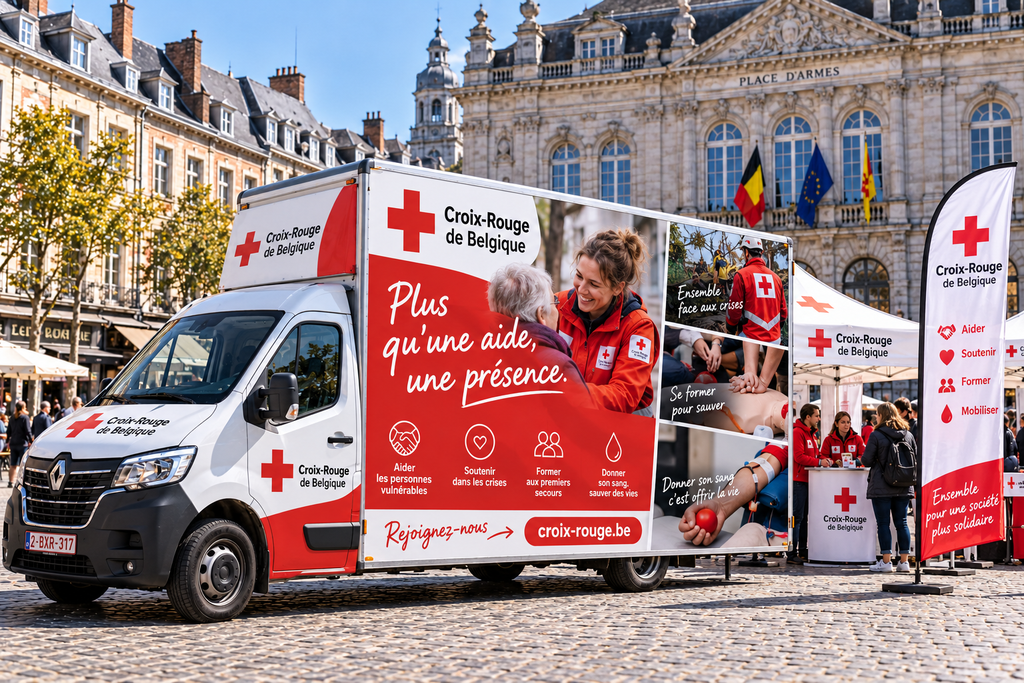
It is important to distinguish a mobile billboard campaign from simple advertising livery on a vehicle.
At first glance, advertising vehicle wrap involves dressing a vehicle in a company’s colours and messages. When it is driven as part of the company’s usual activity, the advertising travels with it.
A mobile billboard campaign, by contrast, usually relies on a vehicle whose route and timing are organised around a specific advertising objective.
Both solutions can contribute to a brand’s visibility, but they do not necessarily meet the same needs. Their regulatory treatment may also differ depending on how the vehicle is actually used.
What are the different mobile billboard formats?
Mobile billboard advertising covers several media, each with features suited to particular environments and communication goals.
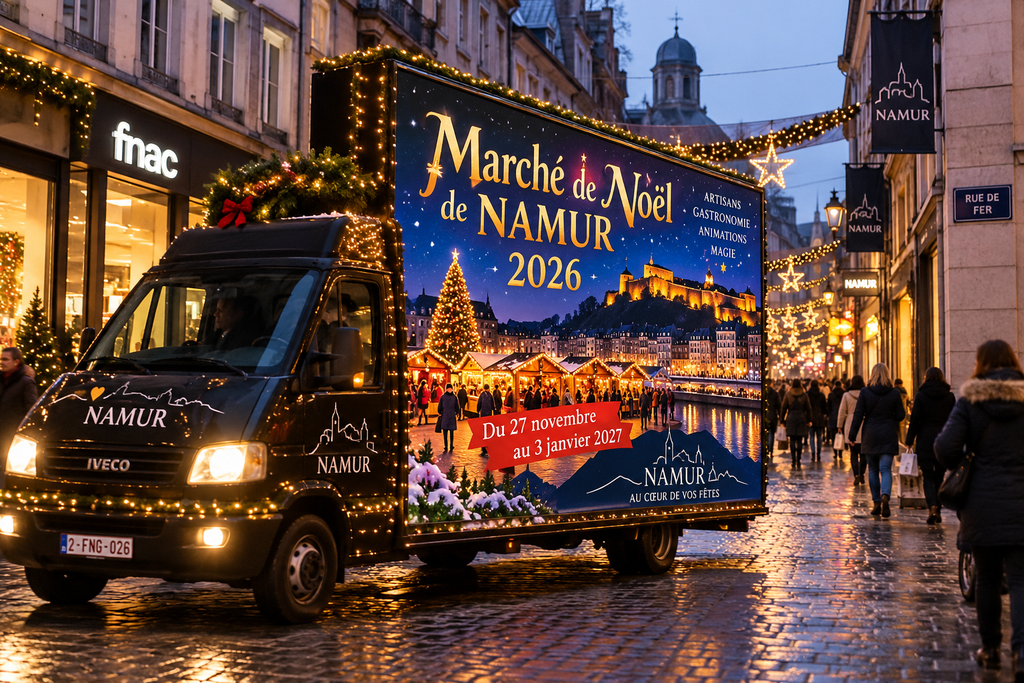
The large-format advertising truck
The advertising truck is particularly suited to campaigns that need a large display area. Its sides and rear carry visuals that can be seen from different angles, especially on main roads and in accessible urban areas.
This format suits awareness campaigns, product launches, shop openings and large-scale promotional operations.
Its main advantage is visibility. On the other hand, its size means routes must be planned to suit traffic conditions, access limits and any local restrictions.
LED screen advertising trucks
Mobile LED screens are a digital alternative to printed billboards. Mounted on suitable vehicles, they can show different advertising content on a single medium.
Depending on the set-up, the advertiser can alternate several creatives, adapt messages to the time of day or feature different offers during a campaign.
This format can be useful for events and campaigns that need changing messages. It does, however, require particular attention to the conditions of use for illuminated screens, their power supply and road safety rules.
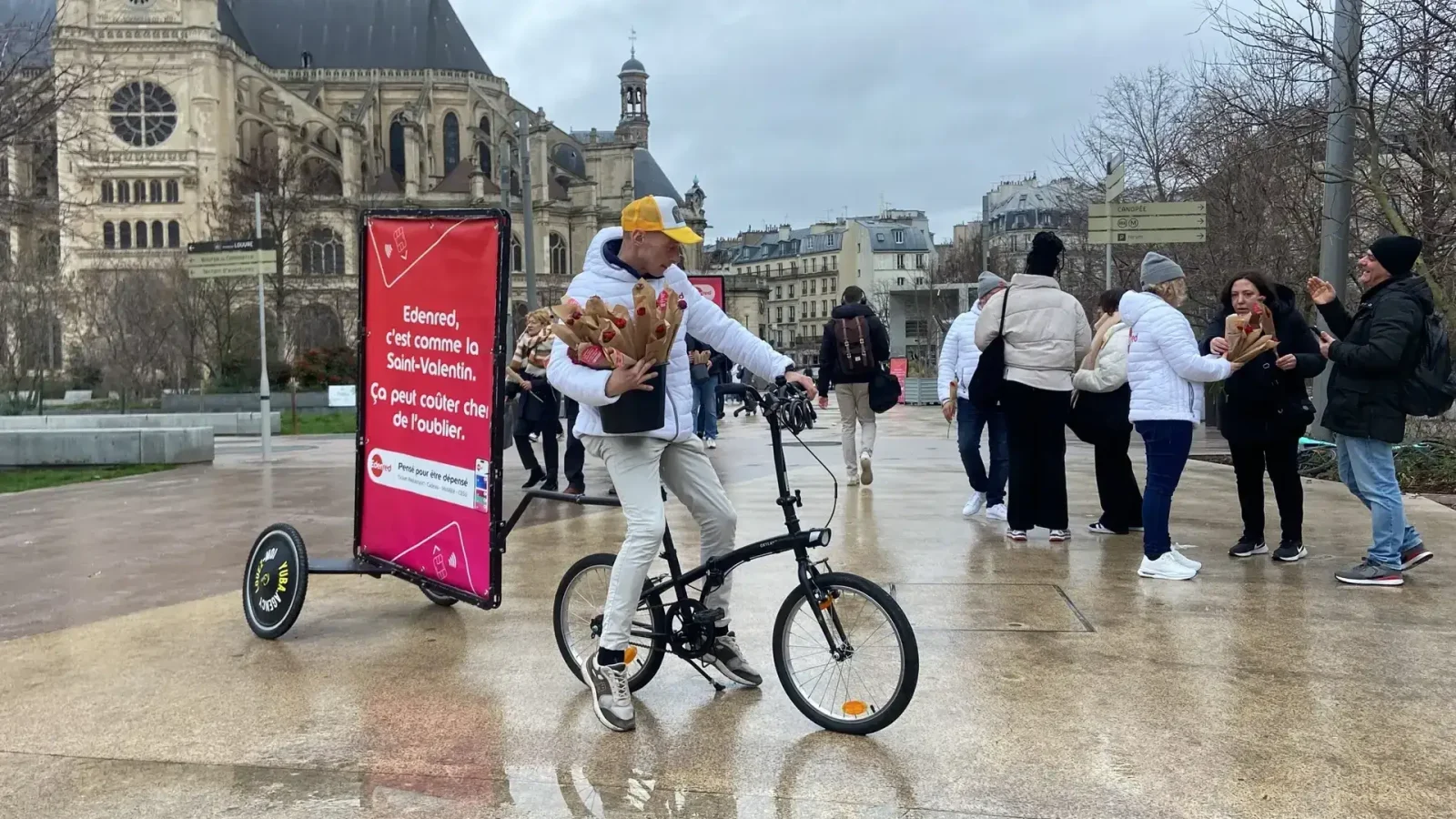
Advertising cargo trikes and bikes
More compact, advertising cargo trikes and bikes make local operations possible in places where large vehicles are less suitable.
They are particularly useful in town centres, shopping districts, markets or for street marketing, subject to access conditions and the necessary permits.
These media can also be paired with promotional teams to hand out flyers, samples or run other promotional activities.
Their value lies more in their closeness to passers-by than in the size of the advertising surface.
Wrapped vehicles and advertising fleets
Vehicle wrapping turns a company’s vehicles into communication media that are visible as they go about their daily journeys.
Company cars, delivery vans or commercial vehicles can thus help build a brand’s awareness in its area of activity.
This solution differs from a one-off mobile campaign: it favours regular visibility over time, but generally offers less control over where and when people see it, since journeys are dictated by the company’s activity.
Comparison of the main mobile billboard media
| Format | Preferred coverage area | Main use |
|---|---|---|
| Printed advertising truck | Accessible urban and shopping routes | Awareness, launch, event |
| LED screen truck | Accessible high-footfall areas | Digital communication, multiple messages |
| Advertising cargo trike | Shopping districts and local operations | street marketing, local activation |
| Advertising bike | Suitable urban routes | Local visibility |
| Wrapped vehicle | Areas served by the company’s activity | Ongoing awareness, brand image |
The choice of medium therefore depends as much on the communication goal as on the area to cover, the available budget and traffic constraints.
What are the benefits of mobile billboard advertising?
Mobile billboard advertising offers several benefits for advertisers who want to complement their out-of-home strategy.
Visibility close to consumers
One of the main benefits of mobile billboard advertising is its ability to bring an advertising message into a range of everyday settings.
An advertising truck or cargo trike can draw attention through its unusual presence in a neighbourhood. Movement, the size of the visual and how it fits into the urban setting can all help make the campaign visible.
Effectiveness nevertheless depends on several factors: how legible the message is, traffic speed, traffic density, exposure time and the quality of the creative.
Flexible geographic targeting
Mobile billboard advertising lets you concentrate advertising resources on areas selected according to the target audience.
A retailer can focus on its catchment area, while an event organiser may want to strengthen its presence on the main access routes to the venue.
Unlike a fixed medium, the route can be organised around several coverage areas during the same campaign.
This flexibility is particularly useful for local operations, event campaigns and time-limited communication.
A complement to other media
Mobile billboard advertising can be part of a broader communication strategy.
Combined with a geotargeted digital campaign, a street marketing operation or social media communication, it multiplies the touchpoints with the public.
A particularly creative set-up may also be photographed or shared on social media. This extra reach remains variable, however, and should not be taken for granted.
The aim is to build a coherent campaign in which each medium contributes to a shared objective.
What does a mobile billboard campaign cost in Belgium?
At first glance, price of a mobile billboard campaign in Belgium varies depending on the chosen medium, the campaign duration, the geographic area and the services needed to deliver it.
There is no single rate that applies to every format. A local operation with a cargo trike does not require the same resources as a campaign using a large-format advertising truck or a vehicle fitted with LED screens.
The main factors that affect the budget
Several elements come into the cost of a campaign:
- The advertising format: printed truck, LED vehicle, bike, cargo trike or another mobile medium.
- The campaign duration: number of days and operating hours.
- The location: target city, distance the vehicle has to travel and route characteristics.
- Advertising production: graphic design, printing, wrapping or preparation of digital content.
- Staffing: driver, technical operator or promotional staff.
- Additional costs: administrative formalities, any local taxes and the necessary permits.
The availability of the media and the campaign period can also affect the price quoted by the provider.
How do you compare mobile billboard quotes?
To compare several proposals properly, it is important to look beyond the advertised daily rate.
A detailed quote should specify the type of vehicle, the services included, the campaign hours, the area covered, production costs and any additional costs.
It is also worth checking whether the provider offers campaign tracking, such as photos of the vehicle in action or a record of the routes actually driven.
The best choice is not necessarily the cheapest option, but the one that best matches the campaign’s objectives and conditions.
In the absence of a Belgian price list that is sufficiently documented and comparable between providers, it is better to Request a quote tailored to your needs rather than relying on price ranges from other markets.
Mobile billboard regulations in Belgium: what you need to know
In Belgium, mobile billboard campaigns must comply with road traffic rules and with municipal regulations on advertising and the use of public space.
The regulatory framework can vary depending on the type of vehicle, how the advertising medium is used, the places it passes through and the parking arrangements.
It is therefore essential to factor in legal and administrative constraints from the moment you start preparing a campaign.
Traffic and parking rules
Vehicles used for mobile billboard advertising must meet the requirements that apply to their category, in particular regarding dimensions, equipment, driver visibility and road safety.
An important rule concerns the parking of advertising vehicles.Article 27.5.3 of the Belgian Highway Code prohibits parking an advertising vehicle on the public highway for more than three consecutive hours.
This limit applies under the regulatory framework currently in force in Belgium. It is not, however, a general permission to park for three hours anywhere: other parking rules and any municipal restrictions still apply.
You also need to take account of changes to the Belgian regulatory framework. From 1 June 2027, new federal and regional provisions are due to replace the 1975 Highway Code. The future texts include in particular the Brussels Public Highway Code, the Flemish traffic regulations and the regionalised Walloon rules.
Vehicles fitted with illuminated screens also require particular attention. Their use must be compatible with road safety requirements and any local restrictions on illuminated advertising.
The role of the Regions and municipalities
Belgium has three Regions: Brussels-Capital, Wallonia and Flanders. Rules on outdoor advertising and the use of public space can differ from one area to another.
Municipalities also play an important role in regulating certain promotional activities.
For example, the City of Brussels requires prior authorisation for certain advertising activities and advertising uses of public space. Parked advertising vehicles whose lettering or wrap exceeds the dimensions normally allowed for a vehicle of the same type may, in particular, be treated as advertising stands.
For the operations concerned, the complete application must reach the administration no later than six weeks before the planned date. Supporting documents may be requested, in particular regarding insurance and the characteristics of the set-up.
Conditions are not necessarily the same in other Belgian municipalities. Before launching a campaign, it is therefore advisable to check the permits, any taxes and the applicable restrictions with the relevant authorities.
How do you secure a mobile billboard campaign?
Before launching a campaign, a few checks help limit the risk of non-compliance.
It is advisable to ask the provider for information about the vehicle, the insurance suited to its activity and any permits required.
The planned route must also take account of access restrictions, parking rules and the specific rules of the municipalities it passes through.
For operations involving temporary advertising use of public space in Brussels, advertisers can consult the conditions and procedures published by the City of Brussels.
Careful preparation makes for a coherent operation while reducing the risk of interruption or problems during an inspection.
How do you organise an effective mobile billboard campaign?
A mobile billboard campaign is about more than driving an advertising vehicle around. Its success depends on the fit between the communication goal, the target audience, the route and the message.
Defining the campaign objectives
The first step is to decide on the expected outcome.
A campaign may aim to build brand awareness, announce a shop opening, promote an event or drive traffic to a point of sale.
These objectives directly shape the choice of medium, the coverage area and the length of the operation.
A set-up designed to promote a one-off event will not necessarily be organised the same way as an awareness campaign running over several weeks.
Choosing areas and times
The route must be built around the travel habits of the target audience.
Business districts, retail areas, major urban roads or the surroundings of event venues can be of varying interest depending on the time of day.
To identify the most relevant time slots, it is useful to study the available footfall data, traffic flows, activity hours and the local calendar.
Traffic constraints and any permits also need to be taken into account. A busy location is not necessarily accessible to every advertising format.
Designing a legible advertising message
With mobile billboards, reading time can be short. The message must therefore be quick to understand.
An effective creative favours a short headline, a recognisable visual, sufficient contrast and a clear hierarchy of information.
The brand name and the main message must remain easy to recognise from a distance.
For a campaign designed to prompt action, you can include a short web address, a promo code or a QR code where visibility and safety conditions allow.
The key is to avoid overloading the medium with too much information.
Coordinating mobile billboards with other marketing activities
Mobile billboard advertising can strengthen a campaign’s impact when it is synchronised with other communication activities.
A brand running a promotional operation can, for example, combine an advertising vehicle with a social media campaign, geotargeted ads or street marketing.
This coordination means the same message appears across several channels, making it more consistent for consumers.
How do you measure the results of a mobile billboard campaign?
As with other forms of out-of-home advertising, the effectiveness of a mobile billboard campaign should be assessed against the objectives set before it began.
Several indicators help assess whether the campaign was properly delivered and what impact it may have had.
Checking campaign delivery
The first level of evaluation is to confirm that the vehicle actually drove in the planned areas at the planned times.
Depending on the tools the provider uses, a report may include:
- A GPS log of the route driven.
- The campaign dates and times.
- The mileage covered.
- Photos of the medium in situ.
- A record of the content shown, in the case of LED screens.
These elements document how the campaign was delivered. On their own, however, they do not prove how many people actually saw or remembered the advertising.
Estimating visibility and impact
Potential audience can be estimated from the footfall or traffic data available for the areas covered.
It is important, however, to distinguish between the number of people passing through an area, the potential opportunities to see the message and the advertising contacts actually achieved.
For a campaign aimed at generating footfall or conversions, other indicators can be used: redemption of a promo code, visits to a dedicated page, changes in footfall at a point of sale or audience surveys.
Where possible, comparing results before, during and after the campaign can provide further insight.
Reliable measurement rests on a clear methodology, rather than on an audience figure announced without explanation.
Mobile or static billboards: which should you choose?
Mobile and static billboards work in different ways. The former favours geographic flexibility, while the latter offers a continuous presence in a set location.
The choice mainly depends on the campaign duration, the area to cover and the communication goals.
Comparison of mobile and static billboards
| Criterion | mobile billboard | Static billboards |
|---|---|---|
| Location | Route set according to the campaign | Set location |
| Geographic targeting | Several areas possible | Area around the billboard |
| Campaign duration | Adjustable depending on the service | Depends on booking periods |
| Advertising frequency | Varies with the routes | Regular among people who pass the location |
| flexibility | Route and times can be planned | Exposure tied to one location |
| Measurement | Route, photos, estimated audience data | Footfall data and posting reports |
| Uses | Local, event-based and one-off operations | Ongoing awareness and local presence |
When should you favour mobile billboards?
Mobile billboard advertising can be particularly relevant for a shop opening, a product launch, a promotional operation or a time-limited event.
It lets you organise the campaign around the areas of greatest interest to the advertiser, with welcome flexibility in preparing the campaign.
When should you choose static billboards?
Static billboards may be preferable when a brand wants to maintain a regular presence on a busy route or strengthen its visibility among people who make the same journeys every day.
The two solutions can also complement each other in a campaign that combines lasting visibility with targeted advertising activities.
FAQ: frequently asked questions about mobile advertising in Belgium
What advertising surface is allowed on an advertising vehicle in Belgium?
In Belgium there is no single national cap of 12 m² that applies directly to every advertising vehicle. The permitted dimensions and conditions of use depend on, among other things, the vehicle, its technical characteristics and the applicable regulations.
Before choosing a format, it is advisable to have its compliance and any local restrictions checked.
Can an advertising truck park in front of a shop?
Parking a vehicle for advertising purposes is regulated. UnderArticle 27.5.3 of the Belgian Highway Code it is notably prohibited to park an advertising vehicle on the public highway for more than three consecutive hours.
This rule does not automatically allow parking in front of a shop. Depending on the location and the planned operation, other restrictions or municipal permits may apply.
How long should a mobile advertising campaign last?
The duration depends on the objective, the target area and the chosen format.
An event campaign can be concentrated over a short period, whereas an awareness operation may require several days or several waves.
There is no universally effective duration: the schedule must be built around the audience you want to reach and the results you expect.
How much lead time should you allow before launching a campaign?
The preparation time depends on the availability of the medium, the production of the visuals and any administrative procedures.
In Brussels, certain advertising uses of public space require an application for authorisation to the City at least six weeks before the operation.
It is therefore best to plan the preparation early and check local obligations from the first stages of the project.
Is mobile advertising suitable for small businesses?
Yes. Mobile advertising can suit neighbourhood shops, local retailers and small businesses, provided you choose a format that fits their objectives and budget.
A cargo tricycle or advertising bike might, for example, be considered for a local operation, while a large-format truck meets other visibility needs.
Can mobile advertising be combined with flyer distribution?
Yes, where local conditions allow. Some formats can be accompanied by street marketing teams tasked with handing out promotional material, presenting an offer or directing passers-by to a point of sale.
This type of operation does, however, require checking the municipal rules on distribution and on the use of public space.
Mobile advertising: a flexible way to communicate in Belgium
Mobile advertising gives businesses a different approach to outdoor advertising. By combining a visible medium, a suitable route and a schedule built around the habits of the target audience, it makes geographically targeted campaigns possible.
Advertising truck, LED screen, cargo tricycle or advertising bike: each format has its own possibilities. The choice must take into account the communication objectives, the budget, the urban environment and Belgian regulations.
Would you like to launch a mobile advertising campaign in Belgium? Give your brand visibility with a solution suited to your objectives and your coverage area.
Let’s discuss your mobile advertising project and discover the options for your next campaign.