
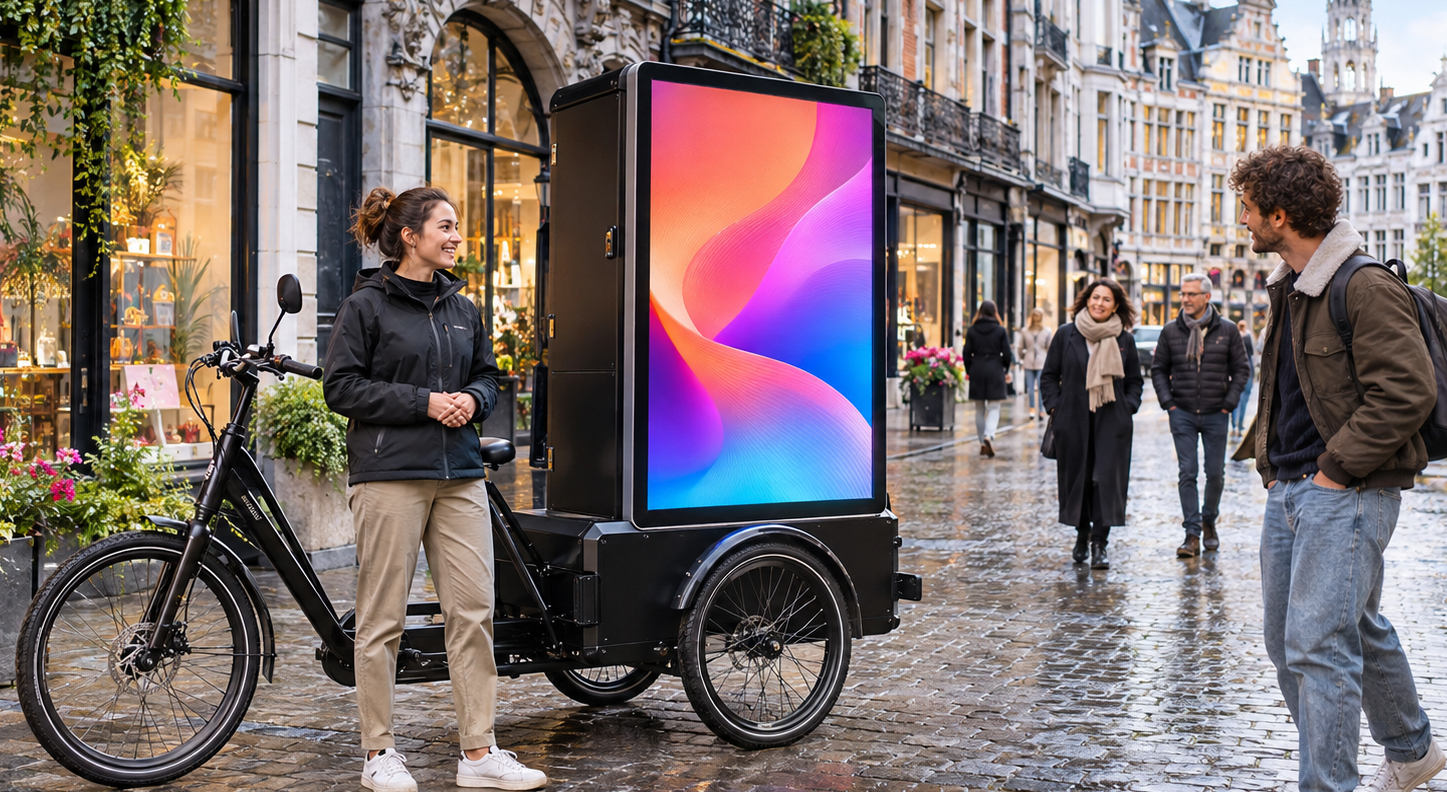
How do you make a brand visible in the places where its audience actually goes? Street marketing creates that encounter through mobile media, targeted distribution and activations adapted to the location.
In Belgium, a successful campaign has to take account of languages, local habits and regulations. Choosing the medium therefore goes hand in hand with choosing the cities, routes and objectives.
Discover the street marketing formats and the key steps to design a campaign suited to your audience in Belgium with Yuba Agency.
What is street marketing? Definition
Street marketing covers advertising and promotional actions carried out in direct contact with the public in urban spaces. It can be used to present an offer, introduce a product or direct passers-by to a shop, an event or a service.
What sets it apart is proximity. A team can explain the message, answer questions and invite immediate action. A mobile medium can also take the communication to several areas, rather than staying tied to a single location.
In Belgium, these campaigns can use advertising bikes, mobile screens, authorised temporary markings or targeted distribution. Their relevance depends on the objective: building awareness, encouraging discovery or obtaining a measurable action.
A QR code can extend the encounter to a dedicated page, a sign-up or an offer. It makes tracking easier, but is not enough to demonstrate the effectiveness of the whole campaign. The quality of contacts, the locations and the results after the visit also need to be considered.
The main street marketing formats
The right medium depends on the message, the audience and the context. A video needs creative that can be read quickly; a banner relies on a strong visual hook; distribution hands people something they can keep.
| Format | How it works | Possible uses | Points to check |
|---|---|---|---|
| Screenbike video bike | Video broadcast on a mobile medium | Launch, event, local visibility | Route, access, stops, legibility |
| Advertising bike with banner | Printed visual carried by a mobile unit | Opening, promotion, repeated presence | Dimensions, route, creative |
| Screenbag backpack screen | Screen worn by an ambassador | Close contact, dense crowds | Movement, comfort, safety |
| Clean-tag and chalk-tag | Temporary floor marking | Wayfinding, proximity, event | Manager’s consent, method, removal |
| Advertising trailer | Large-format unit moved between locations | Events, retail areas, suitable roads | Parking, visibility, permits |
| Door-to-door distribution | Delivery of printed material in a defined area | Local offer, residential coverage | Area, ‘no advertising’ requests, local rules |
These formats do not all work in the same way.
At first glance, screenbike and the banner bike move the message around; the clean-tag stays at the chosen spot; door-to-door distribution delivers material in a residential area. They can complement each other, but their results must be tracked separately.
For a first campaign, it is best to choose a clear set-up and a realistic area. Adding more media only adds value if each element serves a specific purpose.
Preparation also covers languages, transport, weather conditions, any administrative fees and reporting. Request a quote that itemises these costs, so you can compare proposals on a like-for-like basis.
Examples of street marketing by sector
Street marketing can meet a variety of needs, provided the message is brought close to an audience likely to be interested. The following examples describe possible scenarios; they are not completed campaigns or guaranteed results.
- Local shops: announce an opening, present a promotion or direct people to a point of sale. A route around the catchment area and an easy-to-understand offer can shape the set-up.
- Municipalities: inform people about an event, raise awareness of road safety or support civic communication. The media must remain legible, accessible and suited to the audiences concerned.
- NGOs and associations: explain a cause, encourage participation or prepare a fundraising drive. The messaging, the collection arrangements and any data gathered require careful oversight.
- Events and festivals: announce a line-up, help with wayfinding or liven up the surroundings of a site. The organiser’s consent does not necessarily replace that of the manager of neighbouring spaces.
- National brands: organise a product launch or an activation in several cities. Shared creative can be adapted to the languages, locations and objectives of each stop.
In Brussels, greeting people in French and Dutch can make interactions easier. In Flanders, plan communication suited to a Dutch-speaking audience. In Wallonia, French covers most needs, without forgetting German where the area and the audience justify it.
This adaptation goes beyond translation: timings, footfall and stopping options must also be studied. A hurried crowd near a station does not react like an audience with time to spare at an event entrance.
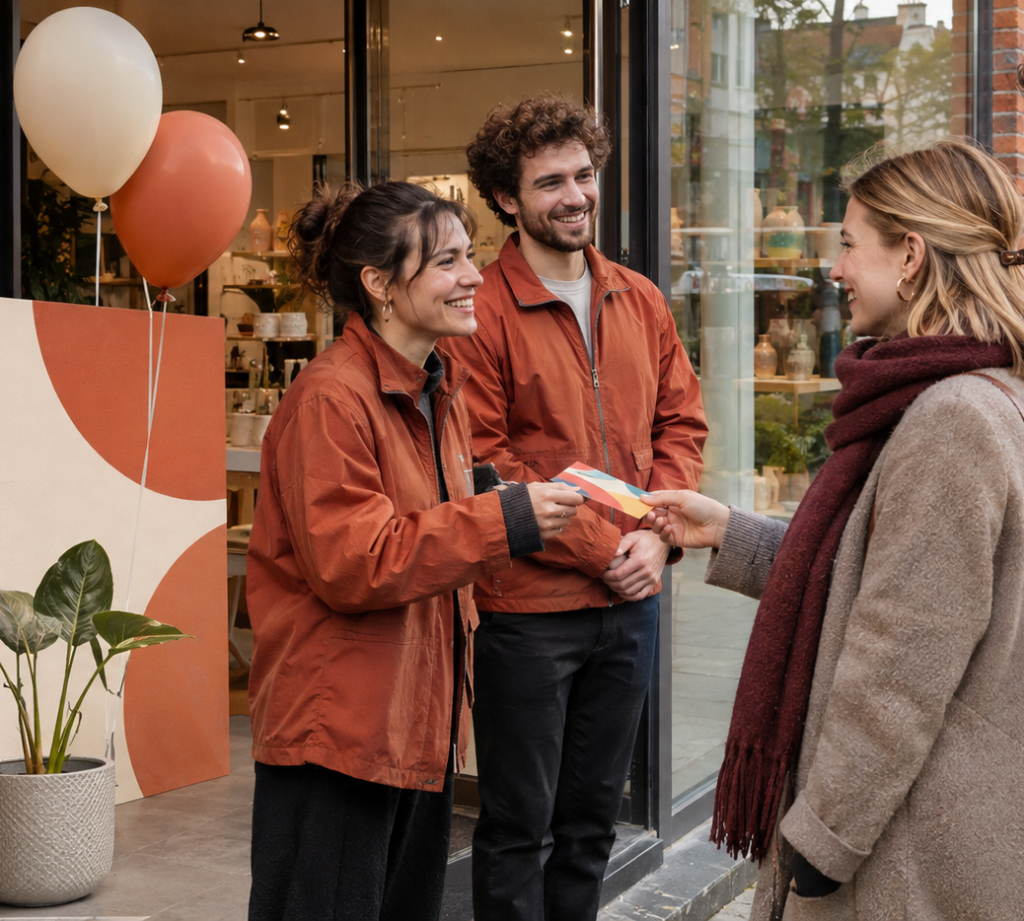
Definition: street marketing
Street marketing refers to advertising or promotional actions carried out in the street and urban spaces, in direct contact with the public. It differs from campaigns run solely on traditional media through its presence on the ground, its opportunities for interaction and its adaptation to the places the audience frequents.
This definition covers several mechanisms: showing a message, prompting an encounter, handing out material or inviting people to discover an offer. The interaction can be human or visual, or extended through a digital tool.
However, it is not a legal category with a single set of rules. A distribution, a worn screen, an advertising bike and a floor installation may fall under different rules.
Street marketing and regulations in Belgium
There is no national permit covering all street marketing operations. The requirements depend on the location, the set-up and the action carried out. Traffic, use of the public domain, advertising and events must be treated separately.
Start by identifying the owner and the manager of the location. A municipal square, a station, a shopping centre and an event site do not involve the same contacts. Then check the formalities with the relevant departments before confirming production and the schedule.
In the City of Brussels, certain temporary advertising uses of public space require an application no later than six weeks before the activity. The same page provides an exemption for certain distributions that do not occupy public space, regarding authorisation from its Posting and Advertising Unit. This exemption does not waive other rules and does not automatically extend to the other Brussels municipalities.
By contrast, Antwerp bans commercial flyering. A practice permitted in one city must therefore never be assumed to be allowed nationwide.
For advertising bikes, the status depends on the vehicle’s actual characteristics. The categories of electric bikes are explained, among others, by the Belgian authorities. The dimensions, the assistance, the trailer and the equipment must be checked for the model used.
Access to pedestrian zones depends on the signage and the restrictions in force. The guide to the rules for cyclists sets out this framework. The right to ride there does not automatically mean permission to set up or carry out a promotional activity.
For markings, posters and installations, check the manager’s consent and any planning rules. In Wallonia, some advertising installations may require a permit. The temporary nature of an action is not enough to exempt it from formalities.
Finally, collecting contact details must comply with the GDPR. TheData Protection Authority points out that the legal basis must be determined for each processing operation.
Advertising emails are also subject to specific Belgian rules.
If you photograph participants to promote the campaign, also take care of their image rights.
How do you measure the results of a street marketing action?
Measurement starts before launch. Define the expected action: visiting a page, discovering an offer, attending an event or getting in touch. Then choose the indicators that let you track this objective.
The delivery indicators show what was delivered: sessions carried out, hours of presence, areas covered, kilometres travelled or materials distributed. They allow you to check the roll-out, but do not on their own prove an audience reached or sales.
The engagement indicators track reactions: QR code scans, visits to a dedicated page, information requests or sign-ups. A separate link per city, medium or session helps compare results, where the tracking set-up allows it.
The commercial indicators relate to qualified enquiries, appointments or attributable purchases. Interpreting them requires taking other channels into account: someone may see the campaign in the street, then search for the brand and buy later.
| Indicator | What it lets you track | Limitation to be aware of |
|---|---|---|
| Flyers handed out | Broadcast volume | Does not prove the message was read |
| Kilometres travelled | Route completed | Does not equal a number of contacts |
| Areas covered | Geographical presence | Does not guarantee full coverage |
| QR code scans | Tracked interactions | Several scans may come from the same person |
| Enquiries or sales | Commercial actions | Attribution to be defined |
Example: an operation costing €3,000 that generates 150 tracked visits works out at €20 per visit. If it then produces ten qualified enquiries, the cost is €300 per enquiry. These two readings do not answer the same question.
After each session, also record the weather, incidents and feedback from the public. Compare similar periods to adjust routes and time slots.

Why mobile street marketing rather than a fixed medium?
The main advantage of mobile is its ability to reach several areas with the same set-up. The route can be organised around peak times, events or neighbourhoods relevant to the campaign.
A fixed medium remains useful for a lasting presence at a specific location. Mobile offers more geographical flexibility, subject to access and permits. The two approaches can therefore complement each other rather than systematically replace one another.
Bike-based media make it possible to consider certain routes where motor vehicles are less suitable. This does not guarantee access to all pedestrian zones: signage, available width and local conditions remain decisive.
The environmental impact must also be described accurately. A 100% electric bike can reduce the use of a motor vehicle along its route, but the campaign also involves production, transport, batteries and the screens’ power consumption. Likewise, temporary marking should not be presented as having no impact at all.
At first glance, FPS Economy sets out good practice for environmental claims. Favour verifiable characteristics over general promises such as ‘100% eco-friendly’ or ‘zero impact’.
Depending on the offer available, a multi-advertiser format can share some costs. Ask for details of broadcast times, the other messages shown and any exclusivity conditions. The comparison should be based on the visibility you are actually buying.
Would you like to organise a street marketing campaign in Belgium?
Talk to Yuba Agency to define your audience, your cities and the expected action. The team can steer you towards a set-up to be priced, with routes, broadcast arrangements and tracking suited to your project.
FAQ
What exactly is street marketing?
Street marketing covers promotional actions in the street, in contact with the public: mobile media, live activations, authorised markings or targeted distribution. It aims for visibility, discovery of an offer or a measurable action.
Is street marketing regulated in Belgium?
Yes. The rules depend on the set-up, the location and the municipality. Traffic, use of the public domain, advertising and data collection may be subject to different obligations. Check the formalities before launch.
What street marketing formats are available in Wallonia and Brussels?
Screenbike video bikes, advertising bikes with banners, Screenbag backpack screens, clean-tag, chalk-tag, advertising trailers and targeted distribution are among the options. Their use depends on local conditions and the necessary permits.
Is street marketing suitable for small businesses?
Yes, with a suitable scope: a neighbourhood, a catchment area or a local event. A clear objective and a targeted campaign let you concentrate the budget, then assess the results before scaling up.
How do you measure the effectiveness of a street marketing campaign?
Combine roll-out data with results: areas covered, contacts, QR code scans, attributable enquiries or sales. Define the indicators before launch; kilometres travelled do not on their own prove commercial effectiveness.
What is the difference between street marketing and traditional poster advertising?
Street marketing focuses on proximity and can include mobility or interaction. Traditional poster advertising generally relies on a fixed location. The two approaches can complement each other depending on the audience, duration and objective of the campaign.